Chinese Herbs by John D. Keys
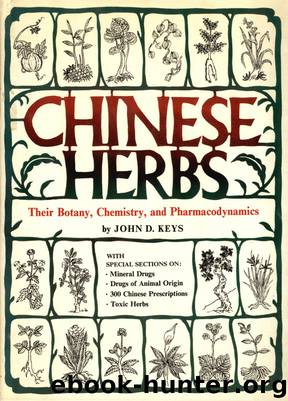
Author:John D. Keys
Language: eng
Format: epub
ISBN: 978-1-4629-0129-6
Publisher: Tuttle Publishing
PAEONIA MOUTAN Sims.
(Ranunculaceae)
Tree peony. A much-branched perennial shrub, 1 m. tall. Leaves alternate, lengthily petiolate, 10-25 cm. long, bipinnate, the ultimate segments oval-oblong, acuminate, 3- to 5-lobed, pale beneath. Flowers solitary, 10-30 cm. in diameter, pink or red; July-August; sepals 5; petals 8-10, obovate; stamens numerous, nearly as long as the calyx. Fruit a densely pubescent follicle. Northern China. Cultivated. (Syn. P. suffruticosa Andr., P. arborea Donn.)
The root is used medicinally. It occurs as cylindrical fragments, 10-12 cm. long by 5-10 mm. thick, epidermis brown, the cross section revealing a very thick cortical parenchyma. The taste is at first sweetish, becoming somewhat bitter. The root contains the ketone paeonol (C9H10O3; white crystalline powder, very aromatic; m.p. 49°; soluble in alcohol, ether, chloroform), glycosides, and benzoic acid.118 Paeonol has been considered to be the monomethyl ether of resacetophenone.75 Melted with KOH, paeonol decomposes to yield resacetophenone, resorcylic acid, and resorcinol.126 Prescribed as antipyretic, emmenagogue, for infections of the digestive tract. Dose, 5-10 gm. Incompatibles: Fritillaria verticillata, Cuscuta japonica, Rheum officinale.
Download
This site does not store any files on its server. We only index and link to content provided by other sites. Please contact the content providers to delete copyright contents if any and email us, we'll remove relevant links or contents immediately.
Inner Engineering: A Yogi's Guide to Joy by Sadhguru(6799)
The Power of Now: A Guide to Spiritual Enlightenment by Eckhart Tolle(5790)
Fear by Osho(4743)
Ikigai by Héctor García & Francesc Miralles(4279)
The Art of Happiness by The Dalai Lama(4133)
The Ultimate Bodybuilding Cookbook by Kendall Lou Schmidt(3950)
Yoga Therapy by Mark Stephens(3750)
The Little Book of Hygge by Meik Wiking(3698)
The Healing Self by Deepak Chopra(3588)
Why Buddhism is True by Robert Wright(3459)
The Hatha Yoga Pradipika (Translated) by Svatmarama(3351)
Being Aware of Being Aware by Rupert Spira(3282)
Shift into Freedom by Loch Kelly(3202)
Wild Words from Wild Women by Stephens Autumn(3157)
Work Clean by Dan Charnas(3130)
Happiness by Matthieu Ricard(3054)
More Language of Letting Go: 366 New Daily Meditations by Melody Beattie(3034)
Yoga Body & Mind Handbook by Jasmine Tarkeshi(2881)
Why I Am Not a Feminist by Jessa Crispin(2764)
